Organic Modern Interior Design Berlin: What It Actually Means in 2026
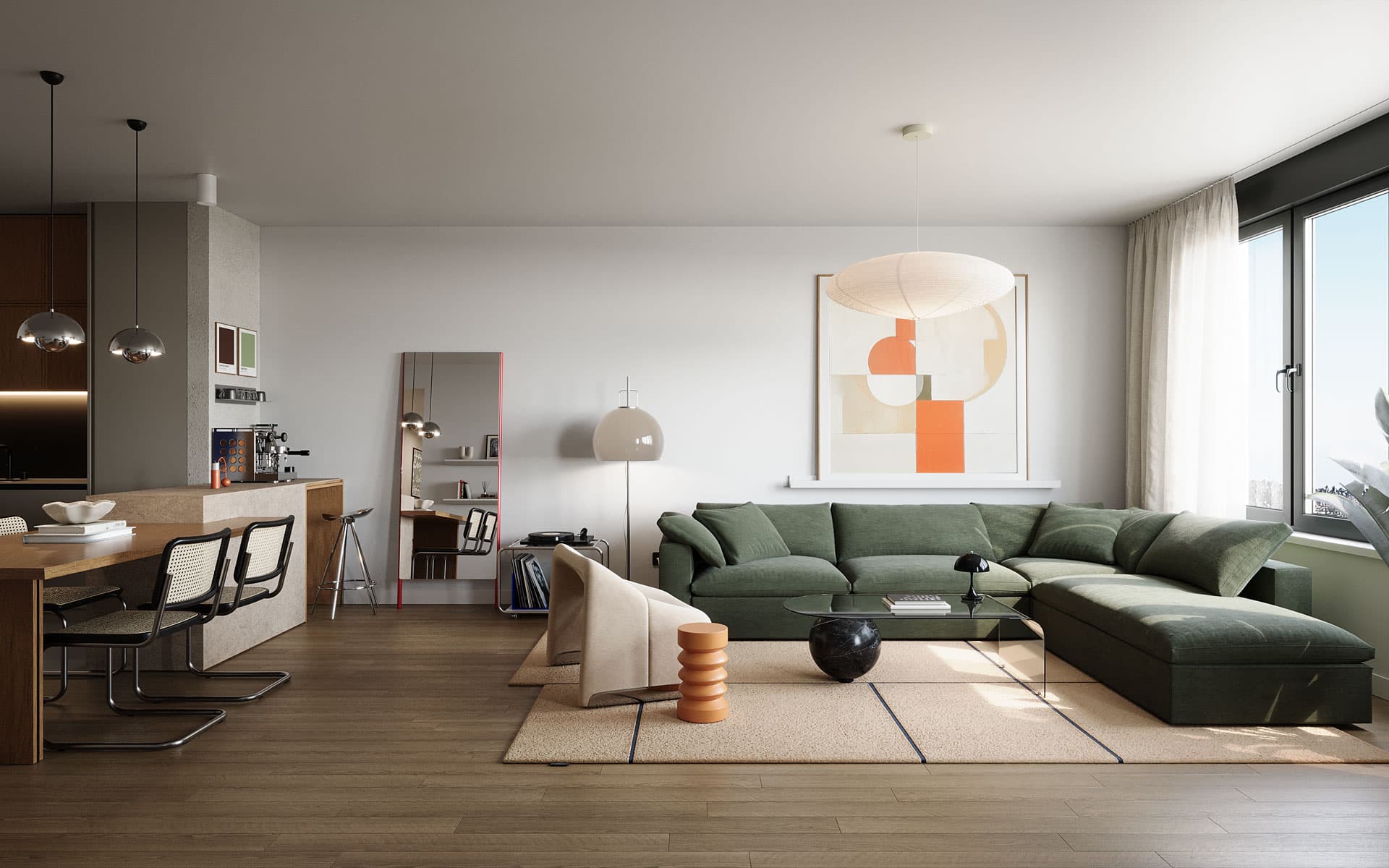
Organic modern interior design in Berlin has become one of the most searched style terms of 2026 - and one of the most frequently misapplied. The phrase combines two ideas that can conflict: the warmth and material imperfection of natural surfaces, and the clean spatial logic of contemporary design. When it works, the result feels settled and specific. When it doesn't, it looks like a shopping list assembled from a trend board. Here is what the style actually demands, and why Berlin's architectural context changes the application in ways that matter.
Organic Modern Interior Design Berlin: The Core Definition
Organic modern is not a style so much as a calibration. It sits between the austerity of hard minimalism and the accumulation of maximalism, using natural materials, warm neutral tones, and softened or curved forms within a contemporary spatial framework. The result should feel coherent and uncontrived - not decorated.
In Berlin, the style intersects with architectural conditions that don't exist in most markets. Gründerzeit buildings from the 1890s to 1910s have high ceilings, ornate plaster cornices, original herringbone parquet, and deep-set windows with thick masonry reveals. Organic modern doesn't fight these bones. It works with them - the inherent material honesty of the architecture becomes a foundation rather than an obstacle. The style extends the building's own logic instead of replacing it.
There is also a climatic argument for organic modern in Berlin specifically. Natural materials and warm tones perform differently under flat northern light, with its long low-angle winter quality, than they do in California or southern Spain. In Berlin, the earthy warmth of the palette is not a trend preference - it is a functional response to the light conditions that shape daily life in these apartments for six months of the year.
The Material Palette: Discipline Over Abundance
The material vocabulary of organic modern is well established: travertine, white oak, linen, bouclé, rattan, unglazed ceramic, brushed bronze, natural stone. The challenge is not sourcing these materials - they are widely available. The challenge is using fewer of them than you want to.
The most common failure in organic modern interiors is treating the material list as a checklist: travertine table, oak floor, linen sofa, rattan pendant, ceramic vase, dried pampas. Each individual element belongs to the style's vocabulary. Together, without a hierarchical logic, they produce visual noise rather than coherence. The discipline is to identify a material register - two or three primary surfaces - and hold that register consistently across the space. Supporting materials (textiles, hardware, accessories) should subordinate to the primary structure, not compete with it.
In our Midcentury Apartment in Berlin, this principle governs every room. A sage green sectional anchors the living area and sets the tonal register. The kitchen extends the palette through travertine-detailed surfaces. The material count stays deliberately low; what changes is proportion, finish, and how each surface responds to light across the day. The coherence comes not from variety but from the relationships between a small number of well-chosen materials.
For a deeper framework on how material hierarchies compound across a full project, our piece on timeless materials in interior design covers the selection logic in detail - the same principles that underpin organic modern's material discipline.
Colour: Warm Neutrals Handled With Depth
The organic modern palette centres on warm neutrals: off-white, sand, stone, warm taupe, terracotta, sage, mushroom, dusty rose. The failure mode - and it is a very common one - is applying these tones uniformly, which produces flatness rather than warmth. The palette requires tonal variation within its own register: different surfaces at different values, so the eye has movement and the space has depth without contrast.
Berlin Altbau walls offer a particular advantage here. Original lime plaster, exposed masonry, or historically textured render carry inherent tonal depth without any added material. In many of the Berlin apartments we work with, the walls already do the work that organic modern is trying to create artificially - a slight unevenness of tone, a surface that catches raking light differently depending on the hour. The designer's task in these buildings is not to add warmth but to preserve and frame what already exists.
Where this fails: painting original plaster surfaces with modern flat emulsion, which eliminates exactly the tonal variation that made the wall interesting. In Altbau apartments, the original wall surfaces are a material asset. Organic modern's palette logic is most effective when it builds on rather than covers the architecture's inherent character.
Curved Forms and Soft Geometry
The curved sofa, the arched mirror, the round dining table, the organic pendant - these are the recognisable formal moves of organic modern, and they work because they introduce soft geometry into spaces that would otherwise read as purely rectilinear. In Berlin apartments, where rooms have sharp prewar proportions and angular transitions, a single curved element recalibrates the spatial register of the whole room.
The error is overuse. Curved forms signal the style, which makes them vulnerable to the same trap as any recognisable stylistic element: over-apply it and you produce caricature rather than character. The arch should have a spatial reason - compressing a transition, softening a corner, creating a focal point in an otherwise flat wall. A curved sofa chosen because curved sofas are current is not the same decision as a curved sofa that addresses a particular room's geometry and circulation pattern.
Organic modern's formal restraint is its most demanding quality. It requires the discipline to not add the next curved element once you have the right one. The style reads as effortless when everything that is present is necessary; it reads as trend-driven when elements are added to complete a look rather than to resolve a spatial problem.
Organic Modern vs Japandi: The Practical Difference for Berlin Apartments
Both organic modern and Japandi use natural materials, restrained palettes, and spatial simplicity. The practical difference is in temperature and textural density. Japandi leans toward precision, flatness, and intentional emptiness - surfaces are spare, edges are sharp, negative space is used as actively as positive space. Organic modern allows more textural richness and more visual weight: a layered throw, a rough-edged ceramic with visible hand marks, a bouclé cushion with deep pile depth, a linen drapery panel that pools slightly on the floor.
In Berlin's climate and interior conditions, organic modern's warmth tends to outperform Japandi's austerity for most residential clients. The style allows a level of comfort and tactility that pure Japandi restraint sometimes sacrifices. That said, the two approaches are not mutually exclusive - many of the strongest Berlin interiors we encounter draw from both, using Japandi's structural discipline to control the spatial framework while organic modern's material warmth fills the lived register.
For a detailed breakdown of Japandi's specific material logic and how it differs at the object level, see our post on Japandi interior design materials - the contrast with organic modern's approach to the same materials is instructive.
Organic Modern in a Berlin Altbau: The Specific Application
The Altbau is the canonical Berlin apartment type: prewar construction, typically 1890-1930, with ceiling heights of 3.2-3.8 metres, ornate plaster cornices, original herringbone or wide-plank parquet, and masonry walls of genuine depth and tactile presence. Organic modern's material logic suits these buildings unusually well, because the architecture already expresses what the style is trying to create: material honesty, craft evidence, human scale in a generous spatial volume.
The practical application is one of extension rather than imposition. Warm linen drapery against stucco cornice. Oak shelving alongside original parquet at the same tonal temperature. A stone kitchen worktop with a surface texture that echoes the masonry walls in an adjacent room. The materials of the intervention and the materials of the building belong to the same family - they confirm rather than compete with each other.
The specific challenge in Altbau apartments is the room-by-room spatial structure. Unlike open-plan layouts where material and colour decisions can be read simultaneously, Altbau plans require those decisions to transition across thresholds - from hallway to living room to dining room to bedroom - while maintaining coherence. A palette that works in isolation in the living room must read as part of a single resolved composition when the door to the hallway is open. This is where organic modern's discipline as a system, not just a room-by-room decoration exercise, is most severely tested - and most clearly visible when it succeeds.
For more on the specific considerations that Berlin Altbau projects introduce - ceiling height, parquet conditions, plaster restoration, structural limitations - see our Berlin Altbau interior design guide.
The Common Mistakes
- The mood-board assembly problem: sourcing every canonical organic modern material without a spatial hierarchy. Each piece is correct in isolation; together, without a governing logic, they compete rather than cohere.
- Curves as decoration: adding arched forms and rounded furniture because they signal the style, not because they address a spatial condition. The arch needs a reason.
- Colour flatness: applying warm neutrals uniformly across all surfaces. The palette requires tonal variation within its own register - different values on different planes, so the space reads as warm and dimensional rather than flat and monochrome.
- Ignoring architectural context: organic modern in a 1960s Plattenbau requires a different material approach than in a 1900 Altbau. The building's bones determine which moves are available and which are working against the architecture.
- Accessory accumulation: adding more ceramic objects, more dried botanicals, more textural elements past the point where they contribute. The style's warmth is in its materials and spatial logic, not in the quantity of objects on a surface.
- Synthetic substitution: using linen-look synthetics, engineered wood with no tactile quality, and factory-distressed ceramics. The material intelligence of organic modern is real or it is absent - the copy reads as copy.
Frequently Asked Questions
What is organic modern interior design?
Organic modern is a design approach that combines natural materials - oak, travertine, linen, unglazed ceramic - with clean contemporary spatial logic. It sits between hard minimalism and maximalist accumulation, using warmth and material depth without decoration for its own sake.
How does organic modern work in a Berlin Altbau apartment?
Particularly well, because the Altbau's own material character - lime plaster walls, original parquet, masonry depth - shares organic modern's values. The style extends rather than fights the architecture. The main design consideration is maintaining material and colour coherence across the room-by-room plan structure typical of Altbau layouts.
What is the difference between organic modern and Japandi?
Both styles use natural materials and spatial restraint. Japandi is cooler and more precise, with deliberate negative space and flat surfaces. Organic modern is warmer and more texturally layered - more weight, more tactility, more visual depth from material richness. The approaches are not mutually exclusive and often combine productively.
How many materials should an organic modern interior use?
Two to three primary materials, held consistently across all spaces. More than that, without a very clear hierarchy, and the coherence that makes organic modern legible breaks down. Supporting materials - textiles, hardware, objects - should reinforce the primary register rather than introduce new ones.
If you are planning a Berlin apartment interior or renovation and want to discuss how organic modern's principles apply to your specific space, contact the House of Nuances team for an initial conversation. You can also explore completed projects at our portfolio.
Ready to Bring These Ideas Home?
Tell us about your space and we will show you how these ideas could work for you. The first consultation is free and without obligation.