Interior Design for Luxury Yachts - House of Nuances
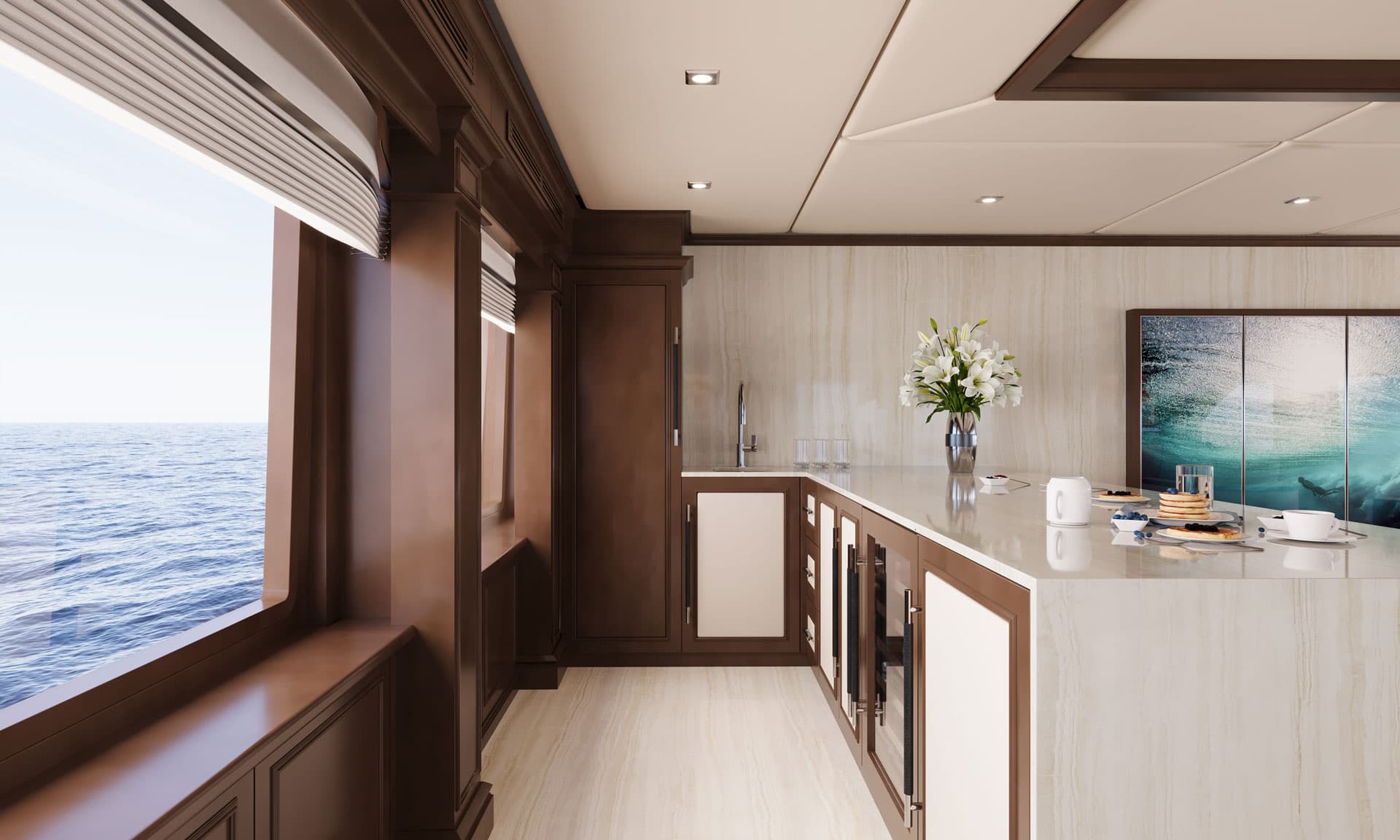
Book Your Free CallInterior design for luxury yachts is one of the most technically demanding disciplines in the field - and one where the difference between a competent designer and the right designer is immediately visible. At House of Nuances, we bring the same material rigour and spatial intelligence we apply to residential projects on land to the specific constraints of marine environments. The result is an interior that feels like a considered home, not a fitted-out vessel.
What Interior Design for Luxury Yachts Requires
Designing for a yacht is not designing a floating apartment. Every decision - from material selection to joinery tolerances to lighting placement - must account for conditions that landlocked interiors never face: constant vibration, salt air, humidity variation, weight distribution, and the way natural light behaves differently on open water at different hours and latitudes.
The space constraints on a yacht are absolute in a way that apartments are not. A yacht interior must perform multiple functions simultaneously - sleeping, dining, entertaining, working - within a fixed footprint that cannot be extended. Spatial planning is therefore not a luxury; it is the foundation every other decision rests on.
- Marine-grade material selection: teak, stainless, anodised aluminium, UV-stable fabrics
- Weight-conscious joinery and furniture specification
- Multifunctional layout planning within fixed dimensions
- Lighting design for artificial and natural conditions at sea
- Climate and ventilation considerations for enclosed marine spaces
Our Approach to Marine Interiors
We approach yacht interiors through the same lens as our residential work: a deep briefing process, a clear material narrative, and a commitment to decisions that hold up over time. On a yacht, the brief extends beyond aesthetics to include how the vessel will be used - owner-operated or crewed, charter or private, coastal cruising or ocean passage - because each use pattern produces a different spatial and material hierarchy.
We do not apply a generic nautical aesthetic. The style of each project derives from the client's own reference points and the vessel's proportions. Our Mirabella yacht project demonstrates this approach: a cohesive interior that reads as resolved and considered rather than assembled from catalogue marine fittings. Read more about our design thinking in our guide to luxury yacht interior design.
Materials Built for Life at Sea
Material selection for yacht interiors requires specification knowledge that goes beyond visual preference. A stone surface that performs beautifully in a Berlin apartment will fail at sea if it is not properly sealed and mounted. Timber species that look identical in a showroom behave very differently under humidity cycling. Fabrics rated for outdoor use onshore may not meet the UV and salt exposure of open-water use.
We work with suppliers who understand marine specification - not simply interior suppliers who sell marine-adjacent products. This distinction matters in practice: it determines whether a fitted interior looks the same after five Atlantic crossings as it did on delivery day. Our material palette for marine interiors typically includes teak and iroko for exterior and wet spaces, engineered stone for galley and head surfaces, anodised aluminium and stainless for hardware, and performance fabrics from specialist marine textile suppliers.
Space Planning and Multifunctional Design
The constraints of a yacht accelerate design decisions that are merely good practice in residential work. On land, a poorly planned room is uncomfortable. On a yacht, a poorly planned space is unusable. We treat the spatial planning phase as the most critical stage of any marine project, spending more time and iteration here than on any other element.
This means understanding how crew and guests move through the vessel, where natural light enters at different times of day, how the interior reads from the cockpit, and how storage integrates with daily living. Our experience with compact, high-performance residential spaces gives us a refined instinct for maximising small footprints without visual compression.
The Design Process for Yacht Interiors
Our process begins with a technical review of the vessel alongside the client brief. We produce a concept document covering spatial layout, material direction and key references, followed by detailed drawings for joinery, surfaces and lighting. For new builds, we coordinate directly with the shipyard. For refits, we work alongside the refit yard's project management team.
We offer full project management through production and installation, and we make site visits at critical stages regardless of where the vessel is located. To discuss a yacht interior project, contact our studio. You can also explore our broader residential interior design work to understand our approach and aesthetic range.
Frequently Asked Questions
How much does interior design for a luxury yacht cost?
Yacht interior design fees depend on vessel size, scope of works, and whether the project is a new build or a refit. For a refit of a 30-50 metre yacht, design fees typically range from €25,000 to €80,000+. We provide a detailed fee proposal following an initial brief review.
Do you work on new builds as well as refits?
Yes. We work on both new build interiors - engaged early in the construction process - and refits, where we redesign an existing interior either partially or in full. Each requires a different process and relationship with the yard, and we are experienced in both.
What size yacht do you work on?
We have worked on vessels from 20 to over 50 metres. Our focus is quality of outcome rather than vessel size - a 25-metre yacht designed with rigour is a more interesting project than a larger vessel fitted out without it.
Can you work with an existing shipyard or refit facility?
Yes. We integrate with established yard relationships and existing project management structures, providing clear documentation and maintaining direct communication with production teams throughout the process.
Ready to Get Started?
Schedule a free consultation with our team to discuss your vision and explore how we can bring your space to life.