Interior Design Berlin: What Altbau Apartments Demand
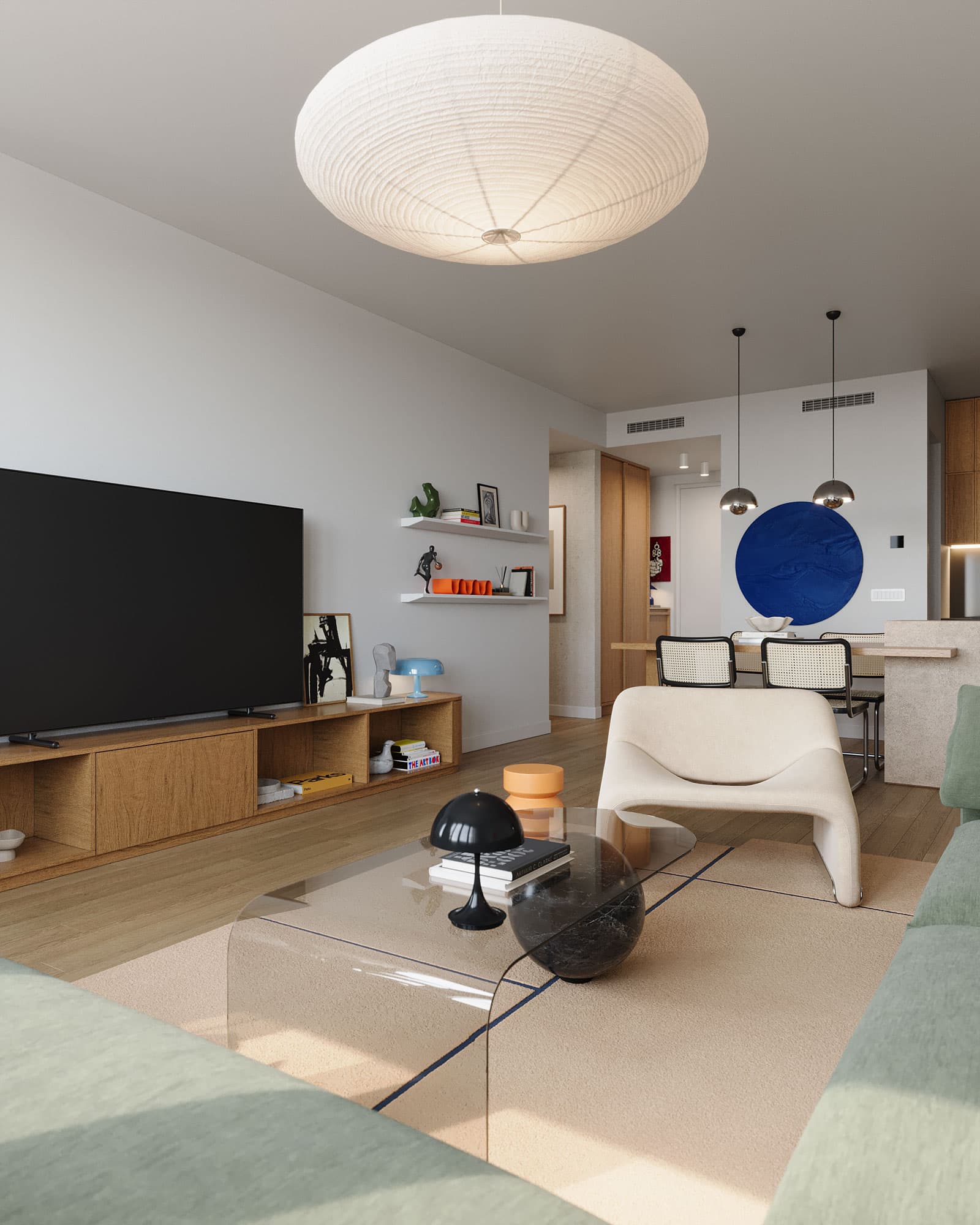
Interior design in Berlin is specific in ways that matter. The city's residential architecture - dominated by the dense Gründerzeit blocks of the inner districts - places particular demands on anyone working in it: demands that are different from what a studio practised in Munich or Hamburg would encounter, and very different from what a generalist practice trained on new-build residential understands. The Altbau apartment is the defining format of Berlin interior design, and it rewards those who know how to read it.
Interior Design in Berlin: The Altbau as Starting Point
The Altbau - the pre-war apartment building, typically constructed between 1870 and 1918 - makes up the majority of desirable residential stock in the inner Berlin districts: Mitte, Prenzlauer Berg, Charlottenburg, Schöneberg, Friedrichshain. These buildings share a set of architectural characteristics that define how interior design in them must work.
Ceiling heights of 3.0 to 3.5 metres create a spatial generosity that contemporary construction cannot replicate - but they also make lighting design significantly more complex than in a standard 2.4-metre room. Thick plaster walls register sound and colour differently from modern construction. Large windows, often running nearly floor to ceiling, flood rooms with light but demand careful consideration for furniture placement and privacy. Original parquet floors, where preserved, are a design asset that shapes every material decision above them.
These are not obstacles. They are the design brief - and how a studio reads them determines the quality of everything that follows.
What Berlin Interior Design Demands in Materials
The material palette of a successful Altbau interior acknowledges the building's age without becoming historicist. The temptation in period property is to either strip the architecture entirely - white walls, polished concrete, the affectation of newness - or to over-restore, surrounding original features with period details that tip into pastiche. Neither approach makes good use of what the building actually offers.
The more considered position is complementary contrast: contemporary materials introduced in dialogue with period fabric, each making the other more legible. In our Midcentury Apartment in Berlin, new white oak joinery was introduced alongside original plaster mouldings and a restored herringbone parquet. Neither was disguised or celebrated at the expense of the other - both were held in proportion, and the result reads as a room that has accumulated character over time rather than been assembled at once.
- Natural stone - limestone, travertine, and unlacquered marble complement the weight and permanence of pre-war construction without competing with its warmth
- Solid hardwood joinery - oak, walnut, and ash read as contemporary without conflicting with original woodwork
- Limewash and venetian plaster - wall treatments that create tonal depth rather than flat coverage, shifting in tone under the large north-facing windows common to this building type
- Aged or unlacquered metals - brass, blackened steel, and oxidised bronze develop patina in proportion with the building itself
For a more detailed guide to which surfaces hold up best under residential use over time, our post on timeless materials for lasting interiors covers the material logic that underpins every project we work on.
Ceiling Height and What It Requires from Joinery
The single most practical consequence of Altbau ceiling heights is what they require from joinery. A standard kitchen unit designed for a 2.4-metre ceiling reads as a series of disconnected boxes in a 3.2-metre room - the gap above the units, nearly a metre of empty space, is the clearest indicator of a kitchen that was not designed for its context.
The solution is not necessarily floor-to-ceiling cabinetry throughout - that can feel oppressive in its own right. The solution is a considered relationship between the joinery datum and the ceiling height: in some cases running cabinetry to the full height, in others stopping at a deliberate level that creates a visual cornice line, in others using the transition zone for open shelving or backlit niches that soften the vertical expanse.
Altbau apartments reward custom joinery not only because irregular walls, angled alcoves, and off-square corners are commonplace - though they are - but because the scale of the room demands it. In our Berlin Bedroom project, floor-to-ceiling cabinetry was painted in the same tone as the surrounding plaster, reading as an architectural wall rather than furniture - making the room feel simultaneously larger and more resolved.
Lighting in Berlin Altbau: Working With What the Building Gives You
Berlin's pre-war apartments are well-served by natural light relative to their construction era - the large windows of Wilhelmine architecture were a deliberate response to the relative scarcity of artificial light at the time. This creates a daylight quality that changes significantly between north- and south-facing rooms, and shifts dramatically between Berlin's bright summers and its grey winters.
What Altbau lighting design cannot rely on is the continuous ceiling void that modern construction provides. Plaster ceilings are typically original and often decorated; cutting coves and installing recessed lighting without damaging the existing fabric is technically demanding and sometimes structurally impractical. This pushes lighting design toward floor and wall sources, architectural slots at cornice level, and fixtures integrated within custom joinery elements.
The result is layered schemes - wall sconces, floor-standing fixtures, table lamps, and linear strips concealed within cabinetry or at the junction between original cornice and new joinery - that are often warmer and more atmospheric than equivalent new-build lighting. Not because Altbau apartments are intrinsically better lit, but because the constraints force a more considered approach. We explore this in depth in our post on invisible lighting techniques, where concealing the source entirely is precisely what Altbau ceilings, in their resistance to conventional recessing, often require.
The Open-Plan Question in Berlin Altbau
One of the most frequent requests in Berlin Altbau renovation projects is opening the kitchen to the living space - removing the wall between kitchen and salon to create an open-plan configuration. In new-build apartments this is architecturally straightforward. In Altbau, it is rarely straightforward and sometimes impossible.
The walls of Gründerzeit construction are thick, frequently load-bearing, and in listed buildings subject to Berlin's monument protection laws. Before any open-plan decision is made, a structural engineer must assess whether the relevant wall can be removed or only partially opened. A conservation office consultation may be required in designated buildings - and in some inner-city districts, a significant proportion of the stock carries some form of protection.
Where the wall can be removed, the design question that follows is whether it should be. Altbau apartments were conceived with distinct rooms for distinct purposes - the sequence of salon, dining room, and service areas was intentional. A partially open arrangement, a wide opening rather than full removal, or a kitchen that is visually connected but can be screened, often preserves more architectural value while meeting the practical requirement of a more connected living space. For kitchen decisions specific to Berlin's building stock, our guide to bespoke kitchen design in Berlin covers the spatial and material considerations in detail.
What Berlin's Interior Design Market Actually Looks Like
Berlin's interior design market is unusual by European capital standards: large, fragmented, and highly variable in quality. The combination of an international population, an active property market, and a concentration of creative industries has produced an ecosystem of studios ranging from large commercial practices to single-person residential specialists.
For high-end residential work, the relevant market is narrower. Serious residential interior design in Berlin - involving full project management, custom joinery specification, material sourcing, and contractor coordination - is handled by a relatively small number of practices. What differentiates them is not primarily aesthetic. The differentiators are depth of process: how materials are specified and verified, how contractors are selected and supervised, and how the gap between design intent and built reality is managed on site.
This gap matters most in Altbau renovation projects, because Altbau surprises are inevitable. Walls opened to reveal structural elements absent from any drawing. Floors levelled to find a depth of build that changes kitchen planning entirely. Utilities discovered in locations that require redesigning an entire service run. These are not failures of planning - they are inherent to the building type. The question is whether the design team has the experience to resolve them without compromising quality or timeline.
How House of Nuances Approaches Interior Design in Berlin
House of Nuances is a Berlin-based studio specialising in high-end residential interior design. Our practice is built around the premise that interiors should be material-driven and architecturally considered - designed for the specific building and the specific client, not assembled from catalogues.
In Berlin, that means engaging seriously with the Altbau building type: understanding its structural logic, its material character, and the ways in which contemporary living can be accommodated without erasing what makes the buildings worth living in. We work across the inner Berlin districts, and the recurring lesson is that each building has specific constraints and specific opportunities that must be read and responded to on their own terms.
Our project portfolio - including the Midcentury Apartment and the Berlin Bedroom - shows how this approach translates across different scales and client briefs. To discuss your project, contact our studio to begin a conversation.
Frequently Asked Questions
How much does interior design cost in Berlin?
Full-service residential interior design in Berlin is typically structured as a percentage of construction costs or as a time-based fee. The design fee is best understood as a quality-assurance investment: professionally managed Altbau renovations consistently stay closer to budget and timeline than self-managed projects, and avoid the costly revisions that arise from uncoordinated decision-making on site.
What is an Altbau apartment in Berlin?
Altbau - literally "old building" - refers to pre-war residential construction, typically Gründerzeit buildings erected between 1870 and 1918. These apartments are characterised by ceiling heights of 3.0-3.5 metres, thick plaster walls, large windows, original parquet floors, and ornate plaster mouldings - making up the majority of desirable residential stock in Berlin's inner districts.
Do I need planning permission for interior renovation in a Berlin Altbau?
Cosmetic work requires no permit. Structural changes including removing load-bearing walls always require structural engineering input and usually a building permit. Listed buildings or those in conservation areas require additional approvals. Always verify the status of your building before planning structural work.
How long does a full Berlin apartment interior design project take?
From initial brief to completed renovation, a comprehensive Berlin apartment project typically takes six to ten months: one to two months for design and specification, two to four months for contractor procurement and manufacturing, and two to four months for construction and finishing.
If you are planning an interior design project in a Berlin apartment and want to discuss what your specific building demands, contact our studio for an initial conversation. You can also explore our full portfolio to see how we approach different building types and briefs. Learn more about our Berlin interior design services or our dedicated Altbau interior design expertise.