Yacht Interior Design: Materials, Space, and Renovation Costs

Yacht interior design is one of the most technically demanding disciplines in the field. Every decision — from the weight of a timber panel to the thread count of a headliner fabric — carries consequences that do not exist in land-based work. Done well, the result is a floating environment that rivals the finest private residences: intimate, materially precise, and completely adapted to life on the water.
Yacht Interior Design: The Constraints That Define the Craft
The distinction between yacht interior design and residential design is not one of aesthetic ambition — both can aim for the same level of refinement. The difference is the system of constraints within which that ambition must operate. On a vessel, weight matters. The structural envelope is fixed and irregular. The marine environment — salt air, UV exposure, humidity, constant vibration — tests materials that would last decades on land within a fraction of that time at sea. And the space itself is in motion.
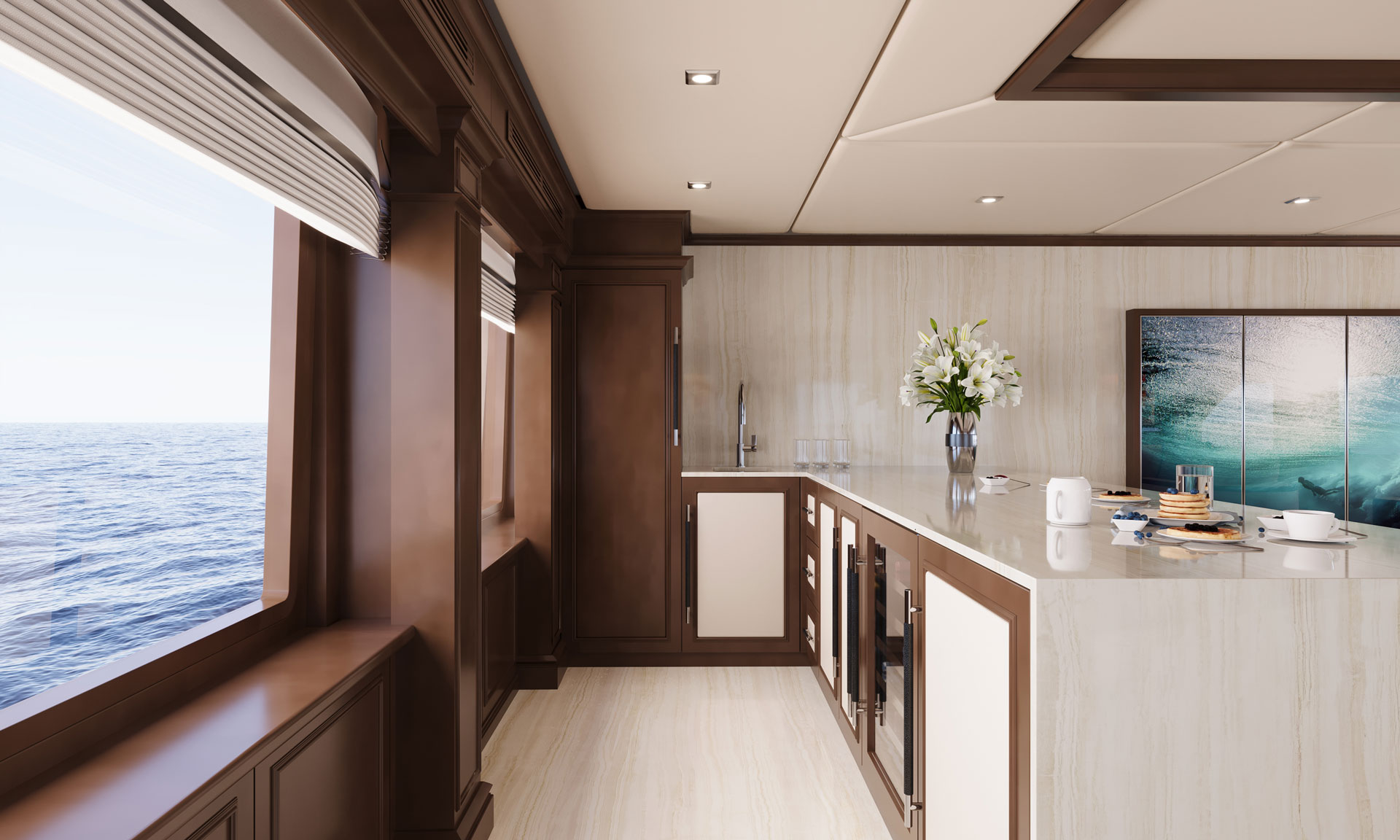
These constraints are not obstacles to good design. They are the conditions that produce it. The discipline of yacht work — the precision of specification, the ingenuity of space planning, the depth of material research — is what makes it valuable as a practice. In our Mirabella Yacht project, every material, every furniture piece, and every lighting decision was made with this system in mind. The result is an interior that performs as well in rough seas as it reads at calm anchorage.
Understanding what yacht design actually demands — technically and materially — is the starting point for any serious commission. What follows is a guide to the decisions that matter most.
Sailing Yacht Interior Design: A Different Set of Priorities
Sailing yacht interior design presents a more demanding set of constraints than motor yacht or superyacht work. The heel angle — typically 15–25 degrees when sailing — affects every ergonomic decision. Furniture that is comfortable at rest becomes awkward or unsafe at speed. Galley layouts must account for cooking at angle. Berth orientation matters differently depending on whether the boat is used for ocean passages or coastal day sails.
Weight distribution is the other governing factor. On a motor yacht, interior weight is a design consideration. On a sailing yacht, it is a performance parameter: too much weight high and aft affects stability and pointing ability in ways the owner feels on every passage. Solid stone countertops — a standard specification on a superyacht — are rarely viable on a serious sailing yacht. The material language has to shift accordingly: lightweight composites, solid timber over hollow core, aluminium cabinetry frames.
The most successful sailing yacht interiors are those that do not try to replicate a motor yacht aesthetic within a sailing hull. They accept the material logic of the sailing context — natural wood, functional storage, low-maintenance surfaces — and bring refinement to that register rather than importing one from outside it. The result is an interior that feels right for the boat: purposeful, warm, and genuinely comfortable at sea.
The same material discipline we apply to high-use residential environments transfers directly here. The principles behind timeless material selection — choosing surfaces that age rather than deteriorate — are even more critical when the environment is actively hostile.
Materials for Tropical and Mediterranean Environments
The marine environment is not uniform. A vessel operating in the Caribbean or Mediterranean faces different material stresses than one in northern European waters. UV exposure is dramatically more intense in tropical latitudes — fabrics, varnished timbers, and certain synthetic materials that perform adequately in temperate conditions will degrade significantly faster in equatorial sun. This is not a minor consideration: material failure at sea is expensive to remediate and disrupts the owner's time on board.
For vessels operating in warm-water cruising grounds, the material palette requires adjustment:
- Teak — for both interior accents and exterior decking — is the established standard for good reason. It is naturally oily, resistant to moisture, and develops a silver-grey patina in UV exposure that many owners prefer to maintained varnish. For interior use, it reads as warm and nautical without effort.
- Solution-dyed acrylic upholstery — Sunbrella and comparable marine-grade fabrics — is essential for any seating that sees direct sun exposure. The dye penetrates the fibre rather than coating the surface, so UV degradation does not cause fading in the way surface-dyed fabrics fail.
- Anodised or powder-coated aluminium hardware — raw stainless steel is susceptible to crevice corrosion in warm saltwater environments. Specifying the correct grade (316L minimum) and surface treatment prevents the corrosion that makes hardware look neglected within a single season.
- Closed-cell foam cushion cores — open-cell foam absorbs moisture and develops mould in high-humidity environments. This detail is frequently overlooked in yacht interior specification and almost always regretted.
In the Mirabella project, the brief specifically called for a vessel that would be operated in warm Mediterranean and Caribbean waters for extended periods. Every material specification accounts for that operating context — not just aesthetically, but in terms of maintenance cycle and expected service life.
Spatial Strategy: Making Compact Cabins Feel Generous
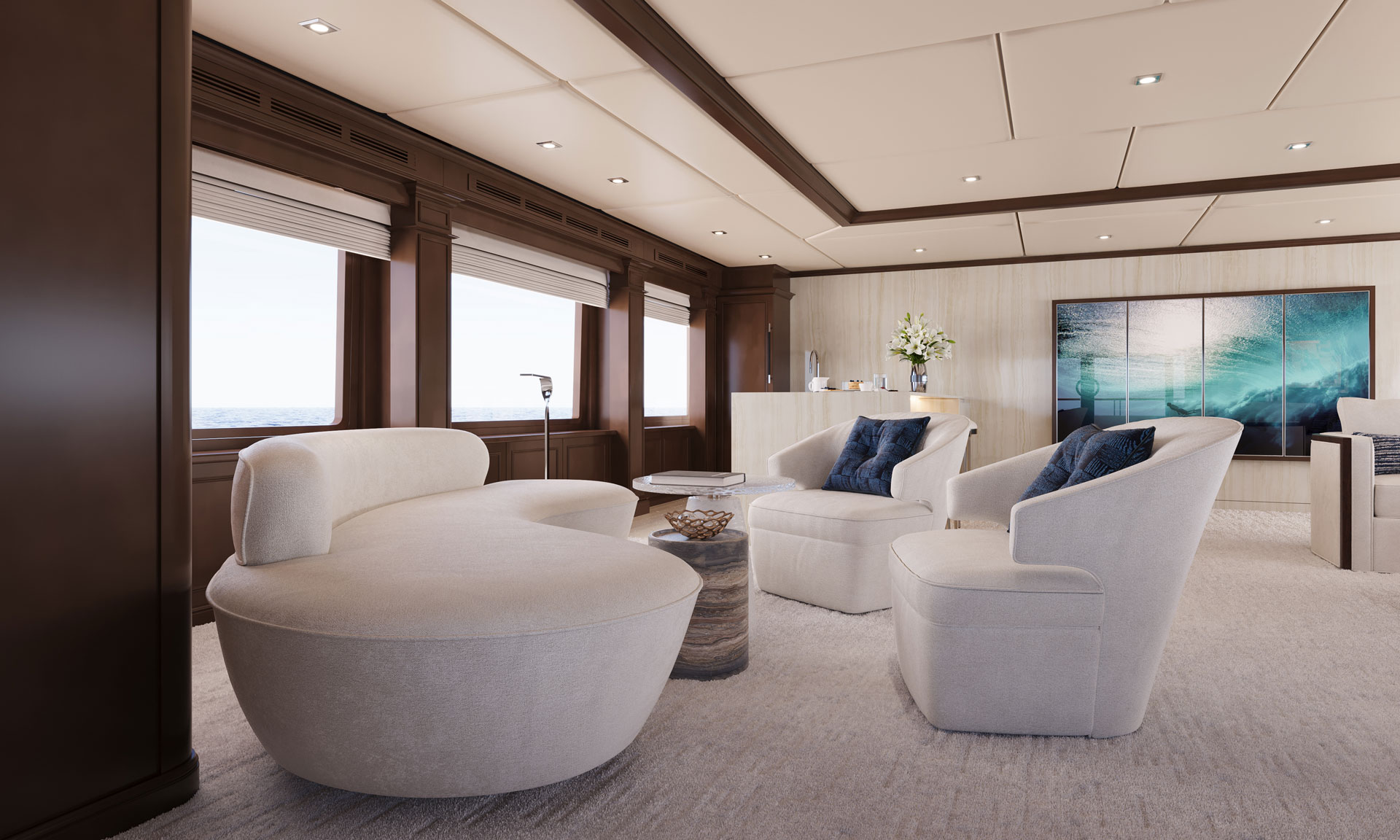
The challenge of perceived space on a yacht rewards consistent, disciplined decision-making. There is no single technique that creates spaciousness — it is the accumulation of many small decisions, all made in the same direction.
Headliner colour and material have a disproportionate impact. A light, matte headliner — off-white, warm grey, or pale linen — lifts the visual ceiling in a way that any darker treatment cannot. Combined with concealed cove lighting that washes the headliner from the edges, the effect of height can be significantly amplified beyond the actual measurement. Our approach to invisible lighting in luxury interiors applies directly here: on a yacht, the light source should never be visible, only its effect.
Joinery design is the other major lever. Built-in furniture with flush fronts and integrated handles removes the visual noise of freestanding pieces. Storage integrated into every possible void — beneath berths, inside stair treads, within helm seat bases — keeps surfaces clear. A clear horizontal plane reads as space; a cluttered one does not, regardless of actual dimensions.
Mirrors used deliberately — opposite a portlight, at the end of a passageway — add apparent depth. The placement requires care: a mirror that reflects another interior surface simply doubles the interior. A mirror that reflects sky or water borrows the exterior and imports it below decks, which is a different quality entirely.
Light and Atmosphere: Designing for the Water
Light on a yacht behaves differently from light in any land-based interior. The constant movement of water outside creates a dynamic quality of reflected light below decks that changes throughout the day and with sea state. This quality is one of the defining pleasures of living on the water, and the interior lighting design should be built around it rather than against it.
In practice, this means keeping artificial light warm and low in intensity during the day, so the quality of natural light coming through portlights and hatches can be appreciated without competition. Dimmable LED systems with a warm colour temperature — 2700K or lower throughout — are standard on any serious yacht interior. Scene presets for dawn, day, dusk, and night passage allow the atmosphere to shift without effort from the owner.
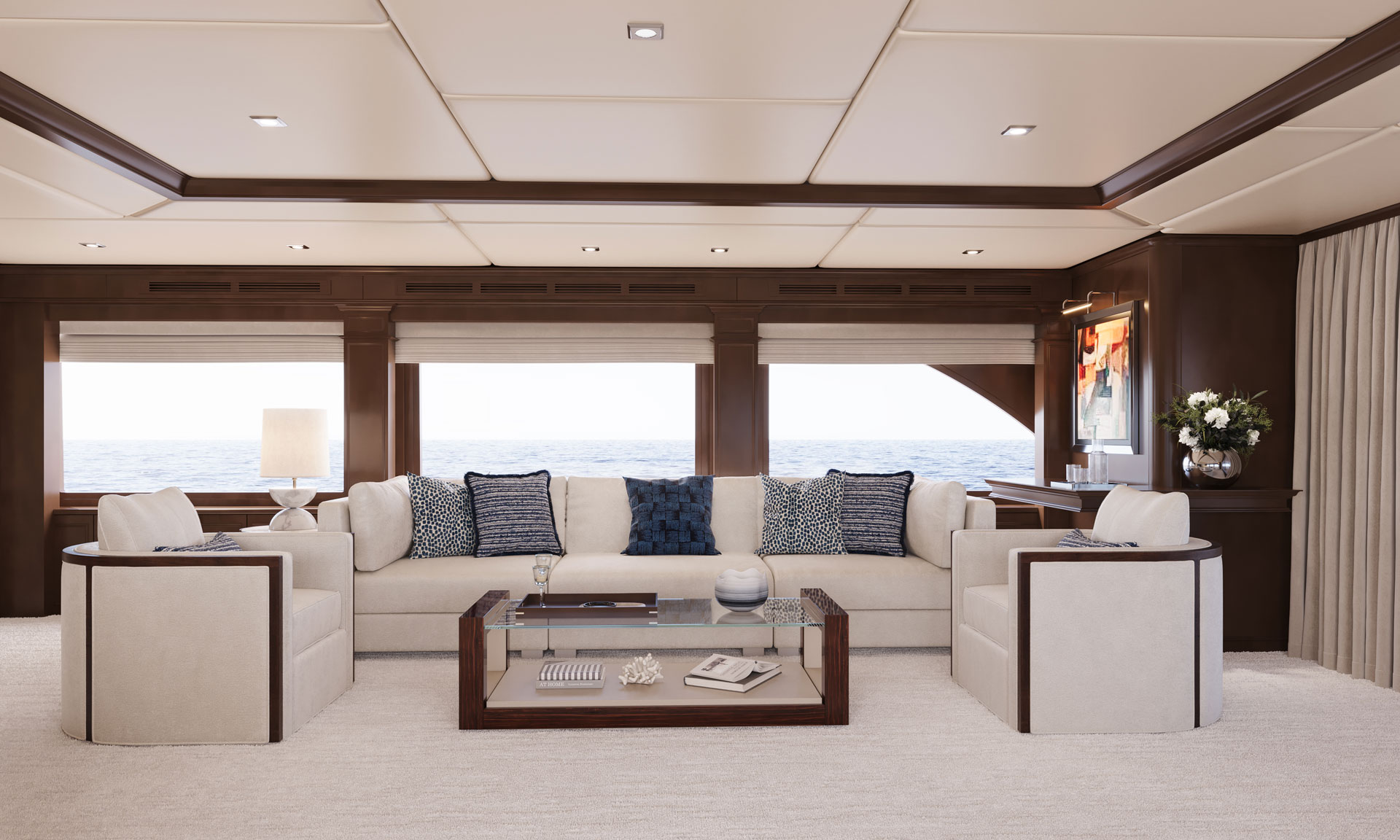
Accent lighting on joinery — a concealed strip under a shelf edge, a recessed spotlight above a piece of art — gives the space depth and drama at anchor in the evening, when the quality of natural light disappears and the interior must hold on its own. In the Mirabella, we designed the lighting architecture around three completely distinct moods: full-day for functionality, evening-at-anchor for atmosphere, and night-passage red lighting for navigation safety without destroying dark adaptation.
Yacht Interior Renovation Cost: What the Numbers Look Like
Yacht interior renovation cost is one of the least transparent topics in the marine industry, and the range is genuinely wide. A cosmetic refresh of an existing sailing yacht — new upholstery, headliner, flooring, and paint — can be completed for €30,000–€80,000 on a 40–50-foot vessel. A full structural refit of a 24-metre superyacht, replacing all joinery, systems integration, soft furnishings, and lighting, will typically fall between €500,000 and €2 million, depending on specification level and the yard undertaking the work.
The variables that most significantly affect yacht interior renovation cost are:
- Material specification — solid timber versus veneer, natural stone versus engineered alternatives, and the grade of upholstery fabric account for the largest spread in material cost
- Custom joinery — bespoke fitted cabinetry is substantially more expensive than adapted standard units, but is usually the only viable option on a yacht where no two dimensions repeat
- Systems integration — replacing or upgrading electrical, lighting control, AV, and climate systems during a refit adds significant cost but is far more economical than completing them separately at a later date
- Yard location — refit yards in Turkey and Croatia offer considerably lower labour rates than equivalent facilities in France, Italy, or the UK, with comparable quality at the mid-to-upper tier
- Design and project management fees — typically 12–18% of total project cost, and consistently the most effective investment in keeping the overall budget under control
The most expensive refits we have encountered are those completed without coordinated design oversight — where decisions were made in isolation, materials changed mid-project, and work had to be undone and redone. A clearly specified design package, resolved before yard work begins, is the single most reliable cost control available on any refit of meaningful scale.
Owner Suite and Wellness Design on Modern Yachts
The owner's suite is the space that determines whether a yacht commission succeeds. Owners spend more time in this space than any other — it must function as a bedroom, a study, and a private retreat, in a footprint that is a fraction of what a comparable land-based master suite would occupy.
The priorities are a berth genuinely comfortable for both overnight passages and harbour nights (different requirements — the former needs secure support, the latter needs temperature regulation), storage that accommodates extended cruising wardrobes without requiring multiple trips below, and a bathroom that reads as luxurious without the bulk of a residential wet room.
Wellness integration — a steam shower, a dedicated massage area that converts from the cabin layout, circadian lighting that supports the owner's sleep schedule — is increasingly expected on vessels over 24 metres, and increasingly requested on sailing yachts of 18 metres and above by owners who use their vessels for extended offshore passages where physical recovery matters. In the Mirabella, the owner's bathroom was designed around a deep soaking tub that doubles as a relaxation space at anchor, with a separate high-pressure shower for underway use.
Frequently Asked Questions
What is the difference between superyacht and sailing yacht interior design?
Superyacht design typically prioritises residential luxury within a large, stable platform — materials and proportions closer to high-end residential work are feasible. Sailing yacht interior design is more constrained: weight matters, heel angle affects ergonomics, and material choices must account for vessel performance. The aesthetic tends to be more nautical and restrained, with an emphasis on natural materials and functional design over decorative gestures.
How much does a full yacht interior renovation cost?
Yacht interior renovation cost varies significantly with vessel size and specification. A cosmetic refresh of a 40–50-foot sailing yacht runs €30,000–€80,000. A full structural refit of a 24-metre-plus superyacht — replacing all joinery, lighting, systems, and soft furnishings — typically falls between €500,000 and €2 million. Design and project management fees are usually 12–18% of total project cost and are consistently the most effective investment in keeping budgets on track.
Which materials perform best in tropical and Mediterranean climates?
Teak (interior and exterior), solution-dyed acrylic upholstery fabrics, anodised or powder-coated aluminium hardware, and closed-cell foam cushion cores are the four material choices that most reliably outperform standard alternatives in high-UV, high-humidity operating environments. Varnished brightwork requires significantly more maintenance in tropical conditions and should be specified only where the owner is committed to that upkeep cycle.
How long does a full yacht interior refit take?
A comprehensive interior refit on a vessel over 20 metres typically takes 6–12 months from design sign-off to re-launch, depending on scope, yard schedule, and lead times on custom joinery and specification items. Resolving the design fully before yard work begins — rather than making decisions under time pressure on the slip — is the most reliable way to deliver on time and within budget.
To discuss a yacht interior design commission or refit — whether for a sailing yacht, motor yacht, or superyacht — contact our studio for an initial conversation. You can view our Mirabella Yacht project in full, or explore our wider project portfolio to understand how we approach different scales and typologies.